Design-led residential and commercial construction. We hold the project from the first conversation to the day you turn the key, working with trusted planning and architectural partners so nothing is lost between hands.
Every Oakley project begins as a drawing. Every drawing begins with the same discipline — listen, measure, propose, refine.
We bring together the architectural and planning expertise your project needs, and hold the whole process together so you only ever have one conversation.
Every project is led by a named site manager from first visit to final inspection. The standard is the same whether the work is £30,000 or £3,000,000.
We turn away the projects that aren't the right fit. The ones we accept are the ones we'll be proud of in ten years. It's the only way to build a body of work worth pointing at.
Six categories of work, each with its own discipline. Most projects move through more than one.
Ground-up homes, designed and built around the way you actually live. Modern, traditional, or somewhere considered in between.
Single and two-storey extensions, loft conversions, garden rooms. The work that quietly transforms how a home feels.
Frames designed and cut in our workshop, raised on site. Traditional craft, modern engineering. The work we are best known for.
Full refurbishments, period sensitivity, structural reworking, and roofing across pitched, flat, and traditional forms.
Fit-outs, refurbishments, frontages, and new builds for businesses. Phased around your trading, not around our schedule.
The work that finishes the project. Driveways, terraces, walls, planting — done with the same care as the building itself.
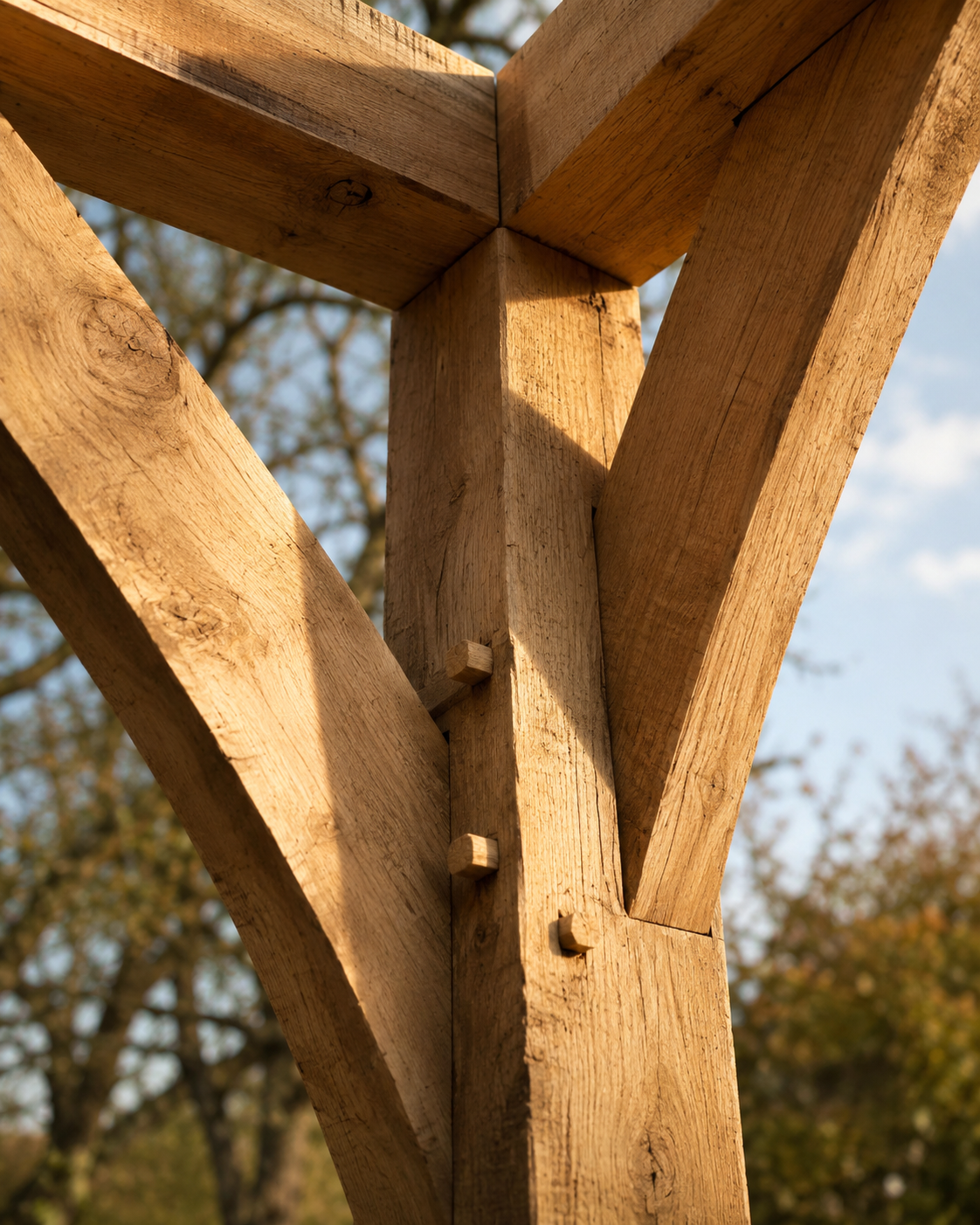
Every Oakley oak frame is designed and cut in our workshop in Cosby, by craftsmen who learned the trade the long way. Mortise and tenon. Oak pegs. Joints made by hand, then raised on site in a day or two.
Most of our work is residential and commercial building. But oak framing is what we are best known for, and the discipline it teaches — patience, accuracy, planning, respect for material — runs through everything else we build.
Site visits within a week. No charge. No pressure. A considered conversation about whether the project — and we — are the right fit.
Six categories of work. Most projects move through more than one. All led by the same team, to the same standard.
Ground-up homes designed around the way you actually live. From single dwellings on individual plots through to multi-unit residential schemes. Each one shaped by the site, the brief, and the time taken to understand both.
Single-storey, two-storey, side, rear, wrap-around. Dormer, hip-to-gable, mansard. The work that quietly transforms how a home feels — done properly, it doesn't read as added on.
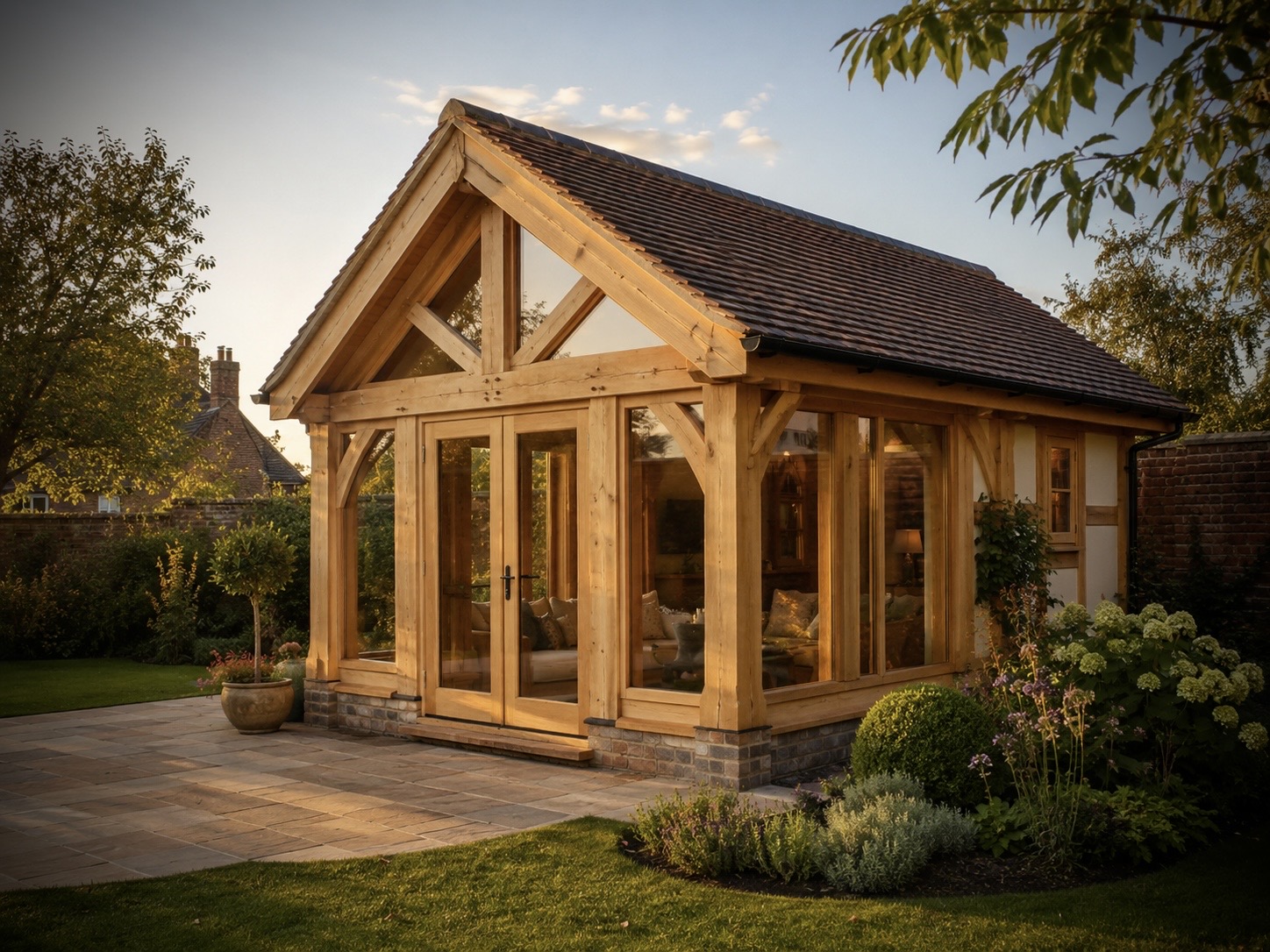
Designed and cut in our workshop in Cosby. Full frames, garden rooms, porches, decorative trusses. Traditional jointing where appropriate, concealed engineering where required.
Full or partial reworking of existing buildings. Period sensitivity where the house demands it. Structural changes handled by our engineers. The kind of work where what's not done is as important as what is.
Pitched and flat roofs, re-roofs, complex repairs. Slate, clay tile, lead, single-ply. The roof is the part of the building most often badly done; we treat it as the part that matters most.
Shop fit-outs, office refurbishments, frontages, change-of-use, light industrial. Phased around your trading hours. Coordinated to minimise disruption to your business.
If a project isn't the right fit, we say so. The work we don't take is the work we wouldn't have done well.
We don't take on emergency repair work or insurance-driven jobs. We don't quote against a long list of other builders without a conversation first. We don't compromise specification to win on price. We don't work without proper drawings, proper consents, or proper contracts. We don't disappear after handover.
A conversation costs nothing. A site visit costs nothing. Tell us what you have in mind.
Six stages. Each with a clear output, a named owner, and a defined point at which you decide whether to continue. We don't ask you to commit to anything until you know what you are committing to.
Within a week of your enquiry, we come to the site. We walk it together, ask the questions worth asking, listen. You receive a written brief within the week that follows — a record of what we discussed, not a quote. There is no charge for this stage, and no expectation that you proceed.
If the project looks viable, we produce a written feasibility note. It covers the likely planning route, the key constraints, our recommended approach, a realistic budget framework, and an honest assessment of risk. Where planning is sensitive, we engage our planning consultants at this stage. You decide whether to proceed before any design work begins.
Drawings produced by our architectural partners, who we have worked with for years. Two review meetings with you during this stage — one at concept, one at developed design. By the end of the stage, the project is fully designed, fully specified, and fully costed.
We coordinate the planning application end-to-end. Our planning consultants handle the strategy and the council correspondence. We handle the client communication, the documents, the timeline. You receive an update at submission, at validation, and at decision — and within a working day of any material change. You do not chase the council.
One site manager, named at the start, present throughout. Trades selected from the same firms we have worked with for years. A site that is tidy at the end of every day. Weekly written progress updates. A clear contract, a clear payment schedule, no nasty surprises.
Snagging done by you, signed off by you. A handover that includes warranties, certificates, maintenance notes, and the contact details of every trade that touched the project. Twelve months of aftercare included, longer for structural work. The relationship doesn't end at handover.
What surprised me most was how little I had to chase. They told me what was happening before I thought to ask.
— Client testimonial placeholder, to be added as projects complete
Whether you're at first conversation or somewhere mid-design, we can pick up from there.
Every Oakley oak frame is designed and cut in our own workshop, by carpenters who learned the trade the long way.
The oldest joint in carpentry, and still the best. A pocket cut into one timber, a tongue cut on the other. They meet, slot, and lock. No nails, no screws, no glue.
Once the joint is together, an oak peg is driven through both timbers. The peg holds the joint tight. The peg is riven from the same oak stock as the frame, so it moves with the timber as it ages.
The oldest pegged oak frames in England are over 900 years old. Their joints are still doing what they were made to do. We work to the same standard, because the material asks it of us.
Mortise and tenon, cut by hand. Oak pegs, riven from the same stock as the frame. Scarf joints used where the design calls for them, made visible because they're a thing of beauty when done well.
The work is patient. A frame for a four-bay house takes weeks in the workshop. Then a crane comes to site and the frame is raised in a day. The clients always come to watch.
We work in green oak, air-dried oak, and reclaimed oak — each suited to different projects. Our default is to recommend what we'd choose for ourselves, not what's easiest to source.
Complete dwellings, designed and built from the ground up. Frame, envelope, fit-out — all to the same standard.
Joined to existing buildings, designed to feel inevitable rather than added on. Especially well-suited to period properties.
Year-round buildings, properly insulated. The most common starting point for a first oak commission.
Often the first frame a client commissions. Rarely the last. Internal decorative trusses where the structure becomes the feature.
It is more expensive than steel, more expensive than masonry, more expensive than most things. The cost is in the timber, in the workshop hours, in the craft itself. A garden room in oak starts around £35,000. A full home runs well into six figures, sometimes seven.
What you get for it is a building that will outlast you. The oldest oak-framed buildings in England are over 900 years old, and the frames are still doing what they were made to do. That's not a marketing claim. It's just what the material does.
If oak isn't the right answer for your project or your budget, we'll tell you that on the first visit. Most of our oak work comes from clients who came to us asking about something else.
A first conversation on site is the right way to begin. We come to you.
Commercial work has its own discipline. Trading constraints, landlord consents, public liability, phasing — the things that make commercial different from residential, and what we plan around from the first conversation.
From shell to trading-ready. Phased so you reopen when you said you would. Built so it looks the part for the customers you want.
Reworking workspaces around how teams actually use them. Often done in stages, around the working week or out of hours.
The face your business shows the street. New shopfronts, signage approvals, heritage-sensitive frontages in conservation areas.
Buildings being repurposed, new commercial premises from the ground up. Planning strategy from our consultants, build from us.
We plan the programme around when you can be closed, partially closed, or fully open. The schedule serves the business, not the other way round.
Most commercial work involves a landlord. We manage those conversations alongside the planning ones, so you only ever speak to us.
If your customers walk past the site daily, what they see matters. We hoard, sign, and tidy as if the public-facing finish was a brand exercise. Because it is.
A first conversation about a commercial project, on site, costs nothing. We come to you.
A site visit, within a week. No charge, no pressure, no commitment. The right way to find out whether we are the right fit.
Oakley Crafted Construction
Cosby, Leicestershire
Monday – Friday, 8.00 – 17.30
Saturday by appointment